Beginner Mahjong FAQ: Your Questions Answered
New to mahjong? Here are answers to the questions every beginner asks, from what tiles you need to how long a game actually takes.
By Silk Mahjong

Everyone who comes to mahjong for the first time arrives with the same bundle of questions. What do I need to buy? How complicated is it really? Will I be able to keep up? How long does this take? These are all completely reasonable things to wonder, and the honest answers are a lot more reassuring than you might expect. This FAQ gathers the questions beginners ask most often and answers them directly.
How many people do you need to play mahjong?
The standard game of American Mahjong is played with four people. Four players sit around the table, one at each side, and the game is built around that configuration. The tile count, the wall structure, and the hand dynamics are all designed for exactly four.
That said, three-player variations do exist. They require some adjustments to the setup and are not universally played, but if you cannot get a fourth, they can be a reasonable substitute. Most experienced players, though, prefer to wait for four. The game simply plays best that way, and the social dynamic of four people around a table is a big part of what makes mahjong what it is.
What is the difference between American Mahjong and other styles?
There are several major styles of mahjong played around the world, and they differ quite significantly. Chinese regional styles like Cantonese, Shanghainese, and Hong Kong mahjong each have their own rules about hands, scoring, and gameplay conventions. Japanese riichi mahjong is another distinct game with unique mechanics including a formal riichi declaration and dora bonus tiles.
American Mahjong has a few features that set it apart from all of them. First, it uses Joker tiles as wild cards, which most other styles do not. Second, and most distinctively, it uses an annual hand card that lists the specific winning hands for each calendar year. This means the valid hands change annually, keeping the game fresh. Third, American Mahjong includes the Charleston, the tile-passing ritual at the start of each hand that is unique to this style.
If you have played mahjong in another tradition and are coming to American for the first time, expect a learning curve around the annual card and the Charleston. The tiles and basic structure will feel familiar, but the strategic language is different.
Do I need to buy a special set to play?
You need an American Mahjong set, which includes 152 tiles (the standard 144 tiles plus eight Jokers), four racks, dice, and typically some scoring chips. Sets come in a wide range of styles and price points, from simple travel sets to beautifully crafted sets with decorative tiles and padded cases.
You do not need to spend a lot to start. A basic set will serve you well while you are learning, and you can always upgrade later if the game becomes a regular part of your life. What matters more than the quality of the tiles is the quality of the mat they sit on: a good mahjong mat protects the tiles, keeps them from sliding, and significantly reduces the noise of shuffling.
One thing to look for: make sure the set is specifically designed for American Mahjong and includes Jokers. Sets sold for Chinese-style mahjong may have a different tile configuration and will not include the Jokers the American game requires.
What is the annual hand card and do I need one?
Yes, you absolutely need one. The annual hand card lists every legal winning hand for the current year, along with the point value each hand is worth. It is the rulebook for what constitutes a valid win, and all four players at the table need to be playing from the same edition.
The card is published once per year by the organization that governs American Mahjong, and it changes each year. This annual refresh is a deliberate design decision: it prevents any single strategy from dominating year after year, keeps experienced players engaged, and gives beginners a fresh start each season.
As a beginner, the card can feel overwhelming at first. There are a lot of hands listed, and they range from straightforward to quite complex. The good news is that you do not need to learn them all at once. Start by finding five or six hands that feel approachable based on the tiles you tend to receive, learn those well, and expand your repertoire from there. Most experienced players have a personal list of favorite hands they build toward regularly.
How long does a game of mahjong take?
A single hand takes roughly fifteen to twenty minutes, depending on the pace of the players and how quickly the winning tile appears. A full mahjong session, which typically involves multiple hands in sequence, usually runs two to three hours.
Most groups play for a set number of hands rather than a fixed amount of time. Four hands, eight hands, or a full rotation where everyone plays East is common. Some groups play until a natural stopping point, like a score milestone or the end of the evening.
If you are new, block out a full afternoon or evening for your first few sessions. You will spend some of that time looking at the card, asking questions, and finding your footing. As you get comfortable with the mechanics, the pace picks up naturally.
How do I learn which hand to build?
This is probably the most important skill in American Mahjong, and it comes with practice. After you receive your tiles and the Charleston is complete, you scan the annual hand card and look for hands that match what you already hold.
Start by looking for patterns in your tiles. Do you have a lot of one suit? Multiple pairs? A spread of flowers? Match what you see against the hand descriptions on the card. The hands requiring the tiles you already have are your candidates.
From those candidates, pick the one that requires the fewest additional tiles. That is usually your best starting point. As the game progresses, keep evaluating. If the tiles you need are not arriving and others are appearing instead, be willing to shift direction.
Over time, you will start to recognize hands quickly and develop favorites. Most experienced players mentally scan the card in about thirty seconds at the start of a hand. That fluency just takes repetition.
What are Jokers and why are they important?

Jokers are wild card tiles unique to American Mahjong. A standard set includes eight of them, and they can substitute for any tile within a set of three or more of a kind. A pung of 5 Crak can be made with two real 5 Crak tiles and one Joker. A kong of 9 Dot could include three real tiles and a Joker.
Jokers cannot be used in pairs. If a hand requires a pair of East Winds, both of those tiles must be genuine East Wind tiles.
Jokers matter because they dramatically expand the range of hands you can build, especially when certain tiles are not arriving from the wall. They also introduce the Joker swap mechanic: if another player has used a Joker in an exposed set, and you hold the tile the Joker is substituting for, you can swap your real tile for their Joker on your turn. This creates interesting dynamics around whether to expose sets containing Jokers.
For beginners, Jokers are a welcome forgiving element. They reduce the frustration of being one specific tile short and make the game more accessible while learning.
What is the Charleston?
The Charleston is the tile-passing ritual that happens at the start of each hand, before any tiles are drawn from the wall. After the deal, players pass three unwanted tiles to their neighbors in a specific sequence: first to the right, then across, then to the left. This constitutes the first Charleston.
After the first Charleston, a second round of passing can happen if the dealer calls for it (passes go in the opposite direction). Following either Charleston, there is an optional direct exchange between players sitting across from each other, called the courtesy pass.
The Charleston gives everyone the chance to improve their hand before play begins. It is one of the features that makes American Mahjong feel more social and strategic from the very first moment. You can read a full breakdown of how it works in our guide to the Charleston.
Can you play mahjong with three players?
You can, though the experience is different. Three-player mahjong typically involves removing one wind direction from the tile set and adjusting the wall and deal accordingly. Some groups also modify how the Charleston works or skip it entirely.
Three-player games can be lively and perfectly enjoyable, but most players find the four-player dynamic to be the richer experience. The game was designed around four positions, and the strategic texture changes noticeably with one fewer opponent.
If you regularly find yourself one player short, it is worth learning the three-player variant so you can still play. But if you have the option of gathering a fourth, take it.
What does self-drawn mean?
Self-drawn means you completed your winning hand by drawing the final tile yourself from the wall, rather than claiming a discard from another player.
On the annual hand card, some hands are marked as self-drawn only. These hands can only be won by drawing from the wall; you cannot call a discard to complete them. These hands typically carry a higher point value because of the additional constraint they place on you.
Knowing which of your target hands are self-drawn only is important. If you are building toward a self-drawn hand and you miss that designation, you might find yourself ready to win but unable to call on a discard. Check the card carefully at the start of each hand.
How do I practice mahjong?
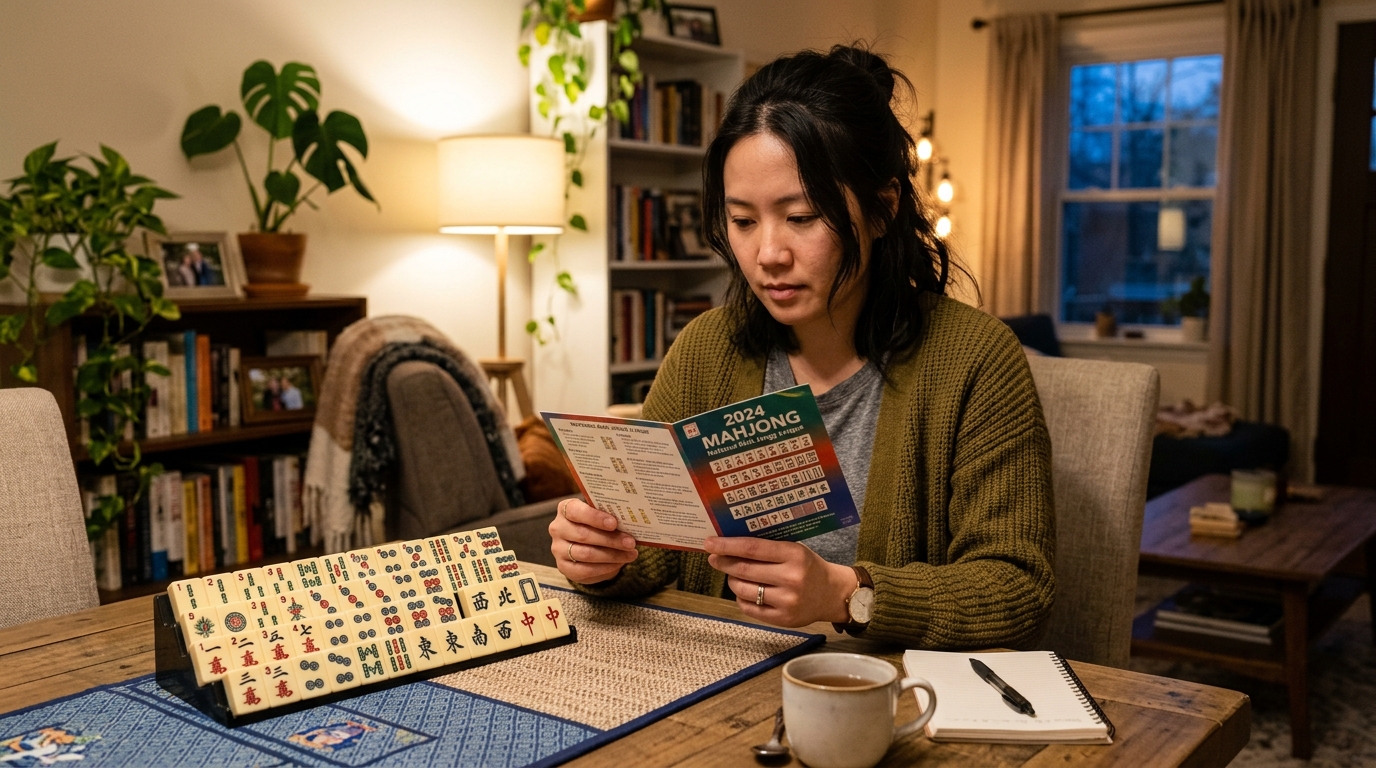
The single best way to practice is to play more. Even imperfect games with patient friends teach you faster than any other method. The tactile experience of handling tiles, reading the card under time pressure, and navigating real decisions simply cannot be replicated any other way.
That said, a few supplementary approaches help. Dealing yourself four hands and practicing the Charleston alone, just to get comfortable with the mechanics, is useful. Reading through the annual hand card regularly until the hands start to feel familiar is time well spent. Watching experienced players, whether in person or through video, helps you see the rhythm and pace of a well-run game.
Some players also find it helpful to drill specific scenarios: deal thirteen tiles, complete the Charleston mentally, and practice choosing which hand to build and what to discard. This kind of solo practice builds the pattern recognition you need before it becomes instinctive.
Is mahjong hard to learn?
It depends on what you compare it to. Mahjong is more complex than most card games but less complex than chess. The mechanics of drawing, discarding, and calling Mah Jongg are not difficult to grasp. The Charleston follows a clear sequence. The core rules can be explained in about twenty minutes.
What takes time is fluency with the annual hand card. Learning to scan it quickly, recognize hands you can build, and make decisions efficiently requires repetition. Most new players need several sessions before they feel genuinely comfortable, and that is completely normal.
The good news is that the learning curve is pleasant. Mahjong is fun even when you are not very good at it yet. The social experience, the physical pleasure of handling the tiles, and the small moments of delight when a hand comes together carry you through the learning period with more joy than frustration.
Where can I find other players?
Mahjong communities are more widespread than most people expect. Local community centers, senior centers, and Jewish community centers often host regular games or can connect you with local groups. Libraries, churches, and social clubs are worth checking as well.
Online, social media groups dedicated to mahjong are active and welcoming. Search for American Mahjong groups on Facebook or similar platforms and you will find communities sharing advice, organizing games, and helping beginners get started.
If you are not finding games near you, consider starting one. Invite three people who have expressed curiosity about the game, get a set, and work through it together. Many long-running mahjong groups started this way. The game spreads naturally because everyone who plays it wants to tell someone else about it.
Mahjong rewards curiosity and patience. The questions you have now are the same ones every experienced player once had. Ask them, get the answers, and sit down at the table. Everything else follows from there.