How to Play American Mahjong
A complete guide to American Mahjong: the tiles, the card, how a hand unfolds, and the moment you finally call Mah Jongg.
By Silk Mahjong

American Mahjong is one of the great parlor games of the twentieth century, and it shows no sign of slowing down. Played in living rooms, country clubs, and senior centers from coast to coast, the game is social, strategic, and tactile in a way that screen-based games simply cannot replicate. If you have been curious about how it works, this guide will walk you through everything you need to know to sit down at a table and play your first hand.
The Tiles
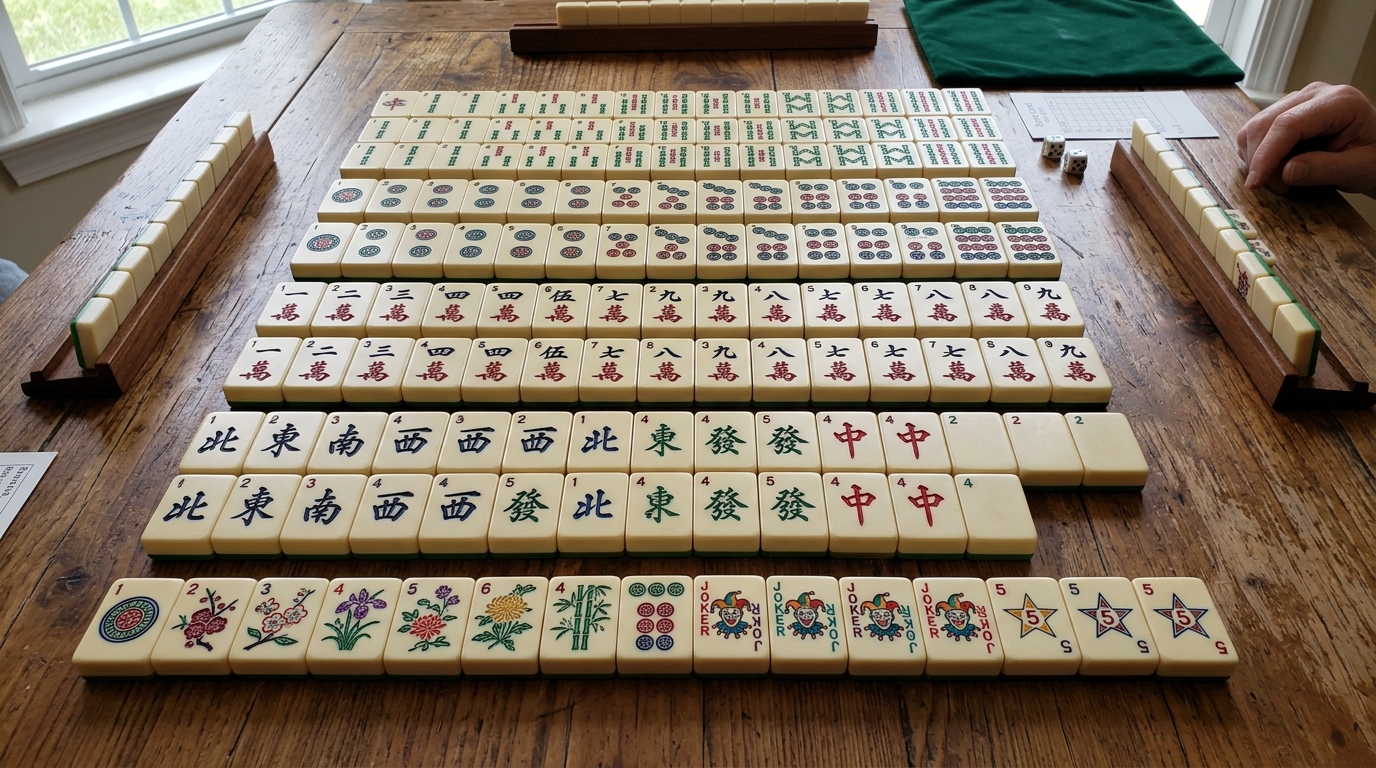
An American Mahjong set contains 152 tiles. Most of the action takes place across three suits:
- Bam (bamboo sticks, sometimes called cracks in some regional dialects)
- Crak (Chinese characters, representing the numbers one through nine)
- Dot (circles, also numbered one through nine)
Each suit runs from one to nine, and each tile appears four times in the set - giving you thirty-six tiles per suit, one hundred and eight in total.
Beyond the suits, the set includes honor tiles: four winds (North, East, South, West) and three dragons (Red, Green, White), each appearing four times. Then come the flower tiles - eight of them, numbered one through eight across two sets.
Finally, the feature that makes American Mahjong distinct from most other styles: eight Joker tiles. Jokers can substitute for any tile in a set of three or four of a kind (called a pung or kong). They are powerful, forgiving, and central to the American game's accessibility.
The Annual Hand Card
Every year, an updated hand card is published for American Mahjong. This card is the rulebook and scorecard in one: it lists the specific tile combinations that constitute legal winning hands for that calendar year.
Each player at the table needs their own current card. Hands are worth different point values depending on their complexity. Some hands require only pungs and pairs; others demand specific sequences across suits. The annual refresh keeps the game fresh and prevents any single strategy from dominating for too long.
If you are new, start by reading through the card and finding a few hands that feel approachable. You do not need to memorize every combination on day one. Most experienced players are still building towards just a handful of their favorite hands at any given point in a game.
Setting Up
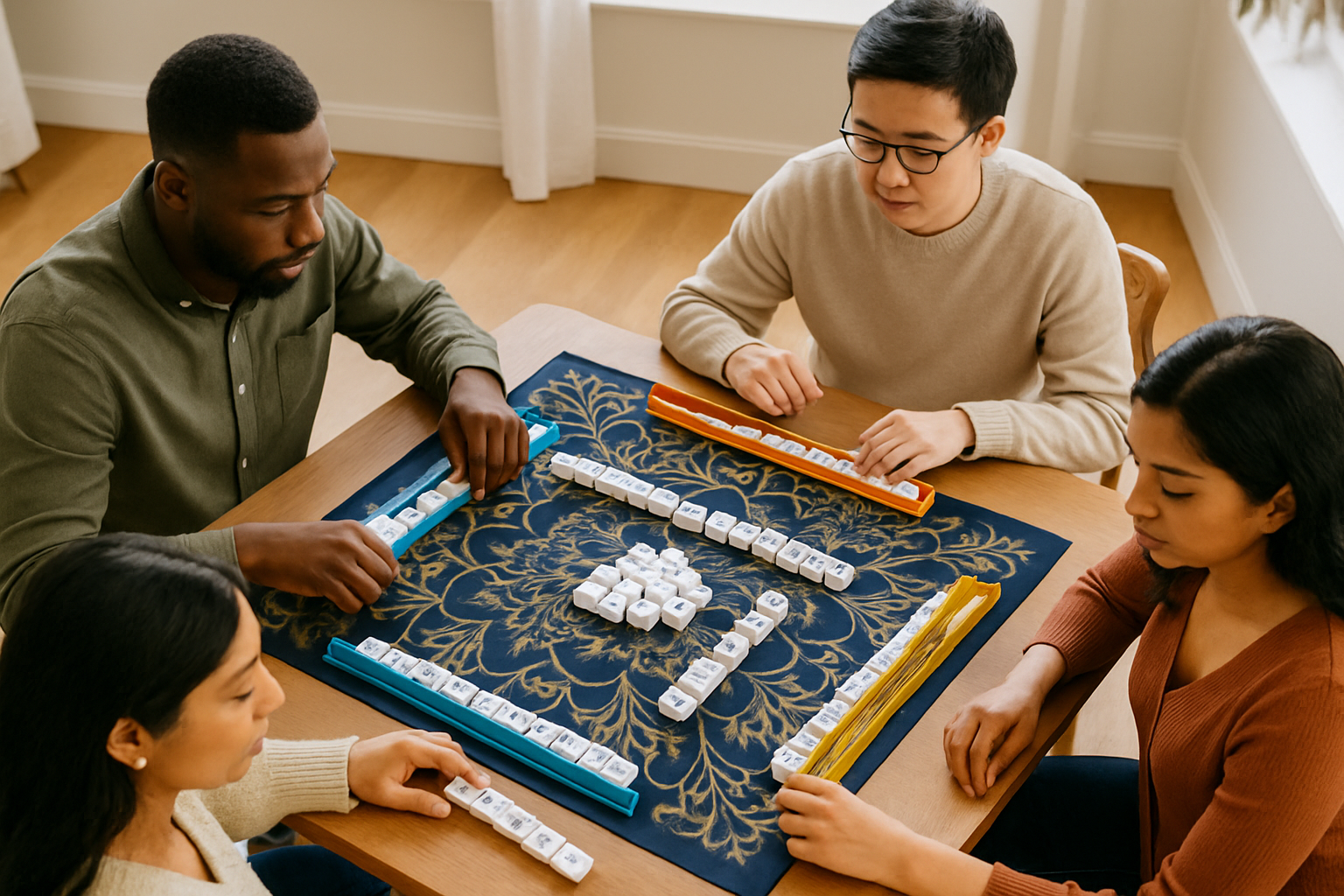
Seat four players around the table. Shuffle the tiles face-down, building four walls of nineteen tiles each to form a square in the center of the table - this is the wall. Roll the dice to determine which player breaks the wall first, and deal thirteen tiles to each player.
Each player arranges their tiles on their rack, hidden from the other three. From this opening hand, you begin the work of deciding which winning hand from the annual hand card you are building toward.
How a Hand Plays Out
Play moves counterclockwise. On your turn, you draw a tile from the wall and add it to your hand. If that tile completes your winning hand, you declare Mah Jongg and reveal your tiles.
If the tile does not complete your hand, you discard one tile face-up to the center of the table, calling out its name as you do. This is where strategy enters: what you discard tells other players something about what you are not building. Veterans read discard piles the way card players read faces.
When another player discards a tile you need, you may claim it - but only to complete a pung (three of a kind), kong (four of a kind), or quint (five of a kind, which requires Jokers), and only if that claimed tile completes your final, winning hand. You cannot claim a discard to extend an incomplete hand mid-game; only to win.
Jokers can be used to complete any set of three or more, but they cannot be used in pairs. And here is one of the more delightful rules in the American game: if another player has used a Joker in an exposed set on their rack, and you hold the tile the Joker is substituting for, you can swap your real tile for their Joker on your turn. Joker-fishing is its own minor art form.
Calling Mah Jongg

When your hand is complete - fourteen tiles that match a hand on the annual card exactly - you call Mah Jongg and reveal your tiles. The other players verify the hand against the card, and scoring follows based on the value listed for that combination.
Some hands are self-drawn only (you win only by drawing from the wall, not by claiming a discard). These are marked on the card and typically score higher. It is worth knowing which of your target hands carry that constraint before you get too far into building them.
A Note on Pace
American Mahjong is not a fast game, and that is entirely the point. A single hand takes perhaps fifteen to twenty minutes; a full evening session involves multiple hands over two to three hours. The game encourages conversation, observation, and the kind of slow-burn concentration that makes time disappear.
Bring snacks. Leave the phones face-down. If you are hosting, lay the mat before anyone arrives. The game will take care of the rest.