Mahjong Tile Meanings: A Complete Visual Guide
A complete visual guide to mahjong tiles: the three number suits, wind and dragon honours, flower tiles, and what the Joker means in the American game.
By Silk Mahjong

Pick up a mahjong tile and you are holding something that has been refined over more than a century of play. The imagery is rich, the symbolism deliberate, and once you know what you are looking at, the set transforms from an abstract collection of carved blocks into something with a genuine visual language. This guide covers every tile in the set, what it represents, and how it functions in the American game.
The Three Number Suits
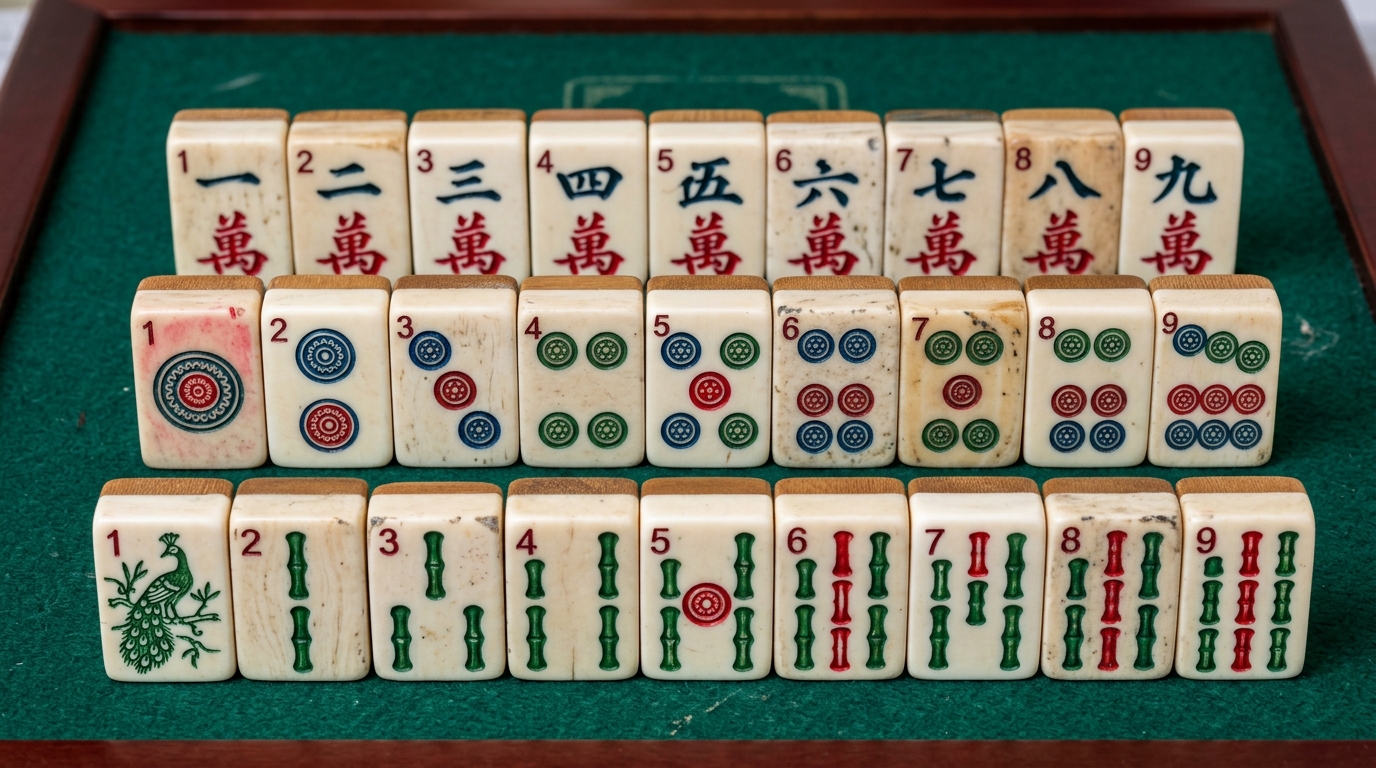
American Mahjong uses three suits, each numbered one through nine and represented four times over, for thirty-six tiles per suit.
Bam (Bamboo)
The Bam suit depicts bamboo stalks. The one-Bam is typically illustrated as a single bird - often a peacock, kingfisher, or sparrow, depending on the set - perched on a bamboo stalk. From two through nine, the tiles show increasing numbers of bamboo shoots bundled together.
Bamboo has deep roots in Chinese symbolism: it represents resilience, flexibility, and endurance. The plant bends dramatically in wind but rarely breaks - a quality that made it a natural metaphor in a game built around drawing strength from a limited hand.
In the American game, Bams are used interchangeably with Dots and Craks as numbered tiles. Many hands on the annual hand card call for matching sequences or pungs across two or all three suits.
Crak (Characters)
The Crak suit - also called the Character suit or the Ten-Thousand suit - shows the Chinese character for ten thousand (萬, pronounced wàn) above the number of that tile's value. The character itself is a potent symbol: in classical Chinese culture, ten thousand represents an uncountably large number, shorthand for abundance and good fortune.
One-Crak through Nine-Crak form a visual ladder of increasing wealth. Many players develop a preference for sets with particularly fine Crak calligraphy, since the brushstroke quality varies considerably between manufacturers.
Dot (Circles)
The Dot suit is the most visually immediate of the three: each tile shows the corresponding number of circles arranged in a geometric pattern. One dot, two dots, up to nine dots, arranged with the kind of graphic clarity that makes the suit easy to read at a glance even for complete beginners.
Circles have a long association with coins in East Asian iconography - the original Dot tiles were said to represent ancient copper cash, with the hole in the center visible in the classical depictions. Modern sets often simplify this to solid discs, but the coin connection lingers in the tile's name in several regional traditions.
The Honour Tiles
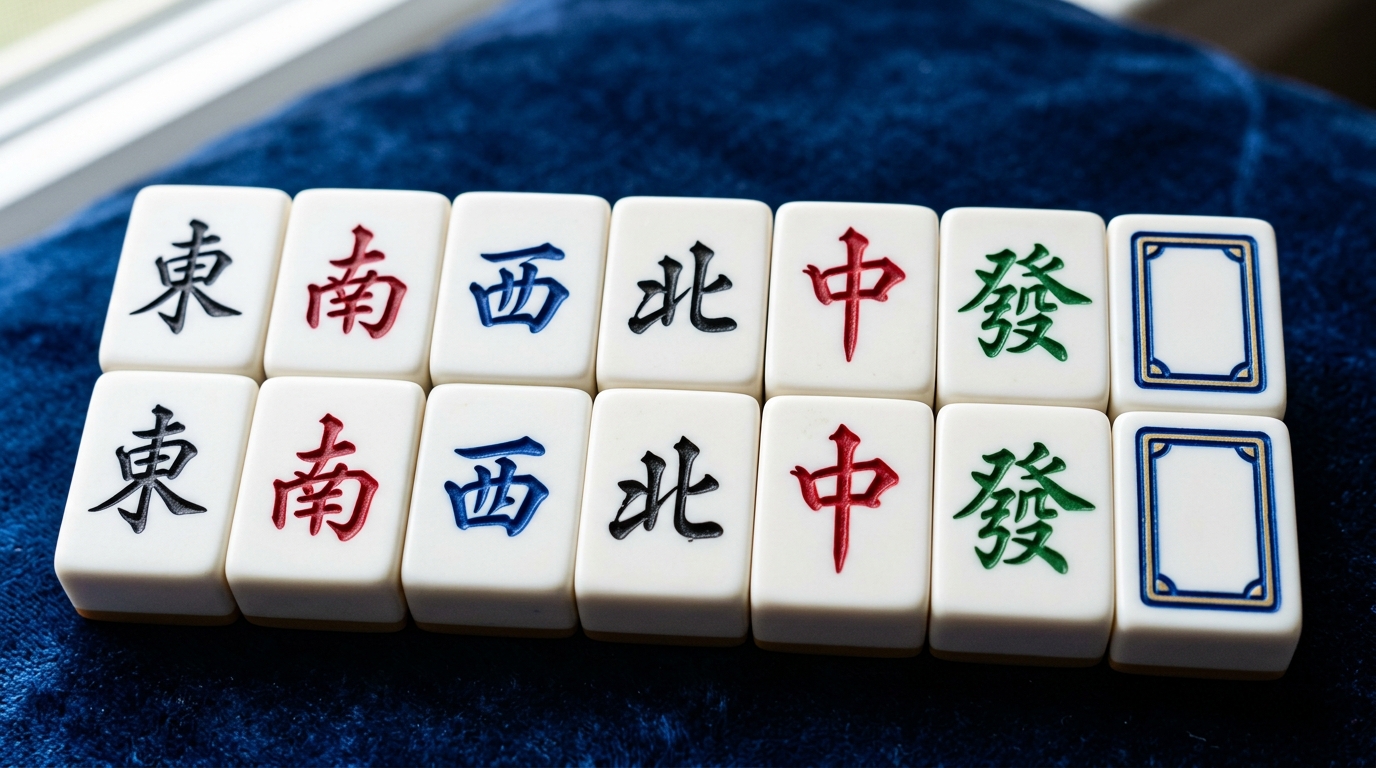
Beyond the three number suits, a standard mahjong set includes two groups of honour tiles: Winds and Dragons.
Wind Tiles
There are four Wind tiles, each appearing four times: East, South, West, and North. In most sets, they are marked with the corresponding Chinese characters (東南西北) or abbreviated Roman letters.
In the traditional game, Wind tiles carry seat-position significance - the player seated in the East position had a particular advantage. In American Mahjong, Winds function primarily as honour tiles used within specific hands on the annual hand card. They cannot form sequences with each other; they are used only in pungs, kongs, or as required by the card's hand definitions.
Winds appear frequently in hands that mix all four values together (the "NNNN EEEE SSSS WWWW" families of hands on the card), making them tiles worth holding if your early draw suggests an honour-heavy game.
Dragon Tiles
Three Dragon tiles, four of each: Red Dragon (中, Zhōng), Green Dragon (發, Fā), and White Dragon (白, Bái).
The Red Dragon carries the character for "middle" or "center" - a reference to China itself and to the central, grounded quality of fire. The Green Dragon's character means "prosperity" or "to prosper" - it is one of the more auspicious tiles in the set. The White Dragon is often simply a blank tile or a white rectangle, its blankness standing for purity and openness.
In American Mahjong, Dragons appear in honour-based hands and occasionally in mixed hands that pair them with specific number tiles. Like Winds, they cannot form sequences; they are used in sets of identical tiles only.
Flower Tiles
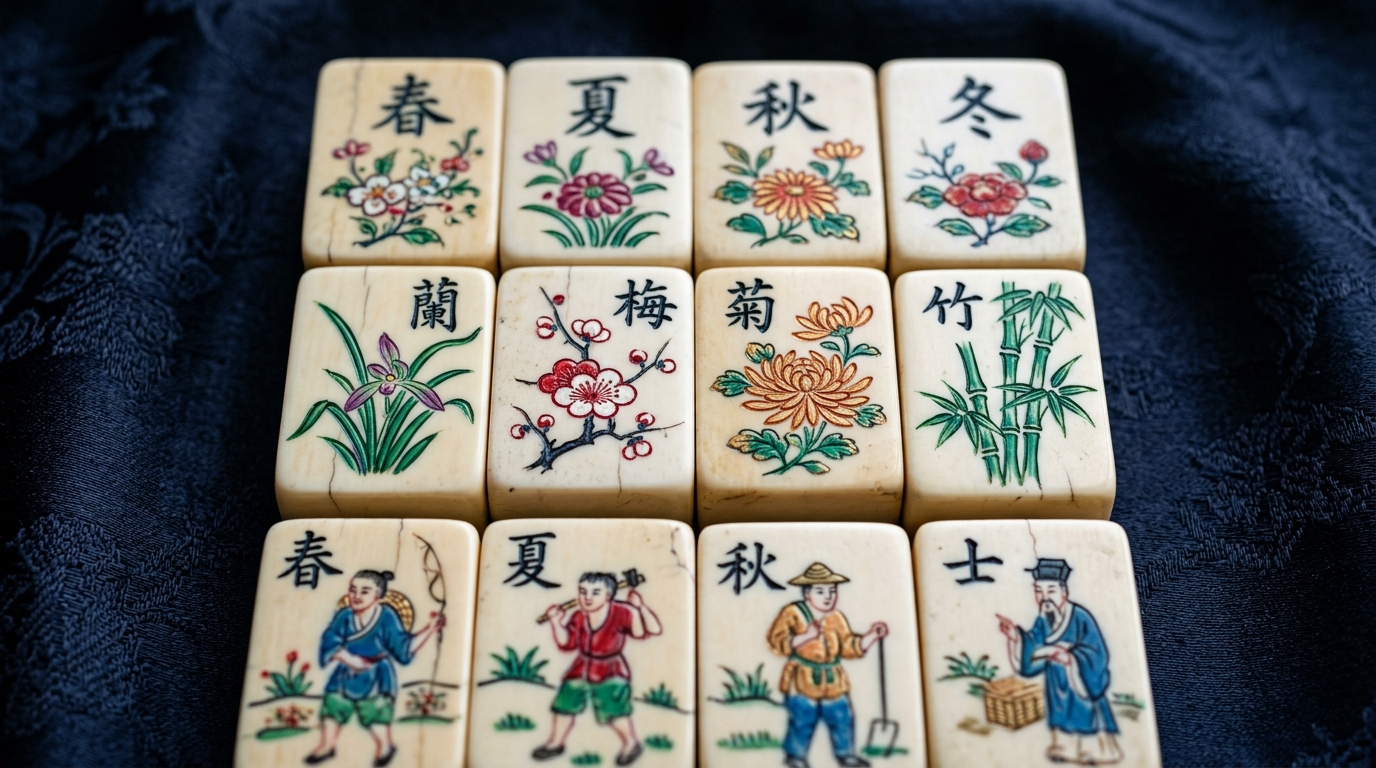
A standard American set includes eight Flower tiles, numbered one through eight across two groups (often called Season and Flower, or simply numbered 1-4 and 5-8). They are among the most artistically varied tiles in the set, frequently illustrated with seasonal flowers, plants, or figures.
Traditionally, each Flower corresponded to a season or a cardinal direction, and drawing "your own flower" - the one matching your seat position - was considered lucky. In the American game, Flower tiles appear in specific hands on the annual hand card, particularly in hands that call for consecutive or matching Flower numbers.
Because there are only one of each (no duplicates within the numbered sequence), Flowers cannot form a pung by drawing the same tile. Jokers are often used in Flower hands to complete sets. This makes Flower tiles simultaneously rarer and, in the right hand, more valuable.
Joker Tiles
The Joker is unique to the American game. Eight Jokers appear in a standard set, decorated with a variety of motifs depending on the manufacturer - jesters, wildcards, or abstract patterns. Their function is entirely practical: a Joker can substitute for any tile in a set of three or more.
The Joker has no historical precedent in older tile-game traditions. It was introduced as the American game developed its own character in the early and mid-twentieth century, and it is now so central to how the game plays that it feels inseparable from the set.
Jokers cannot substitute in pairs. They cannot be discarded once drawn. And as described in the rules, they can be claimed via swapping if you hold the genuine tile they are standing in for. This makes them the most strategically complex tiles in the set despite - or perhaps because of - their apparent simplicity.
Why the Set Matters
A good set is not merely a tool. The tiles carry weight, both literal and historical. Running your thumb across a well-made tile, hearing the particular sound it makes against the mat, watching a Flower or Dragon emerge from the wall - these small sensory details are part of why people play mahjong for decades. The set and the mat are the physical center of the game. Choose them with some care, and they will serve you for a very long time.